The long, fascinating story of a rebirth
Don’t be surprised if, as you enter the Museo Santa Caterina, you detect the trace of a Tuscan accent. For this, back in the early fourteenth century, was where stood the palazzo of the “good Gherardo da Camino”, the feudal lord of Treviso until 1305, and this is where he invited the poet Dante, a fugitive from his native Florence after 1302, to stay awhile.
In gratitude for such kindness and consideration, Dante praised him in both in the Canto XVI of Purgatory, the second volume of the Divine Comedy (La divina commedia), as well as in Book IV (IV trattato) of his earlier, lesser-known, Convivio, a philosophical treatise.
Driven from power in 1305 by a popular revolt that culminated in the assassination of Gherardo’s one son (Rizzardo), and the flight of the other (Guecellone), the Da Camino family’s fortunes were at an end. The family’s palazzo was burnt to the ground, and the ruins were razed to the ground, the area being left abandoned for over thirty years.
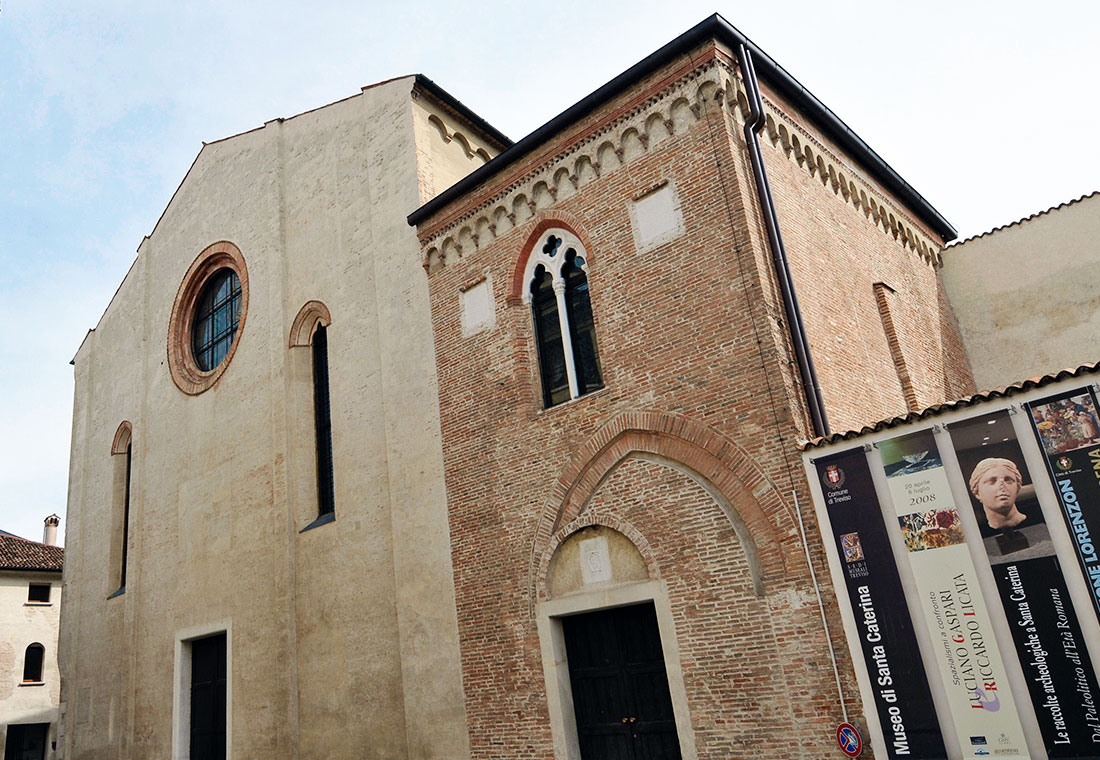
In 1346, the religious order of the Servants of Mary (Ordo Servorum Mariae, in Italian: Servi di Maria) took over the site and started to build a monastery and church dedicated to Saint Catherine of Alessandria.
Suppressed in 1772, with all its religious functions ending in1806, the monastery and its buildings, not least the church, were redeployed as a barracks and as a military depot. The damage wrought during this period, was extensive, not just to the architecture and to the decorations, but also in terms of artworks, artefacts, and furnishings disposed of, or lost.
However, by an incredible trick of fate, the bombing raids of 1944 and 1945, no less, marked a radical change in the fortunes of the old Santa Caterina monastery after many years of neglect
Thanks to the determination of the art restorer Mario Botter, that nondescript plasterwork that had, for centuries, concealed an extraordinary secret was to be hacked away, bringing to light an unparalleled artistic treasure.
Thus it was that the Santa Caterina complex of buildings experienced a veritable rebirth: a restoration programme was set in motion to turn the entire area into Treviso’s museum of archaeology and ancient art.
Today, celebrating Mario Botter’s felicitous discovery, in the square outside the museum stands a work by the distinguished local-born and internationally renowned artist Mario Martinelli, whose work can be seen in, among places, Venice, Milan, Bologna, Paris, Toronto, Antwerp, and Tokyo.
The Santa Caterina complex of buildings offers an open invitation to come in and look around, for traces of this fascinating story can be found all about, such as the:
- fourteenth and fifteenth-century frescoes in the deconsecrated church, the best of which are the Cycle of Saint Ursula (Ciclo di Sant’Orsola) by Tomaso da Modena, which were originally in the (now demolished) church of Santa Margherita degli Eremitani.
- Picture Gallery (Pinacoteca), in the Manica Lunga (Long Gallery) on the first floor, featuring Mediaeval, Renaissance, and Modern Art.
- Archaeological section (Sezione Archeologica) on the ground and basement floors: a wealth of artefacts documenting over 100,000 years of the history of the area around Treviso, from prehistoric times to the Roman era.
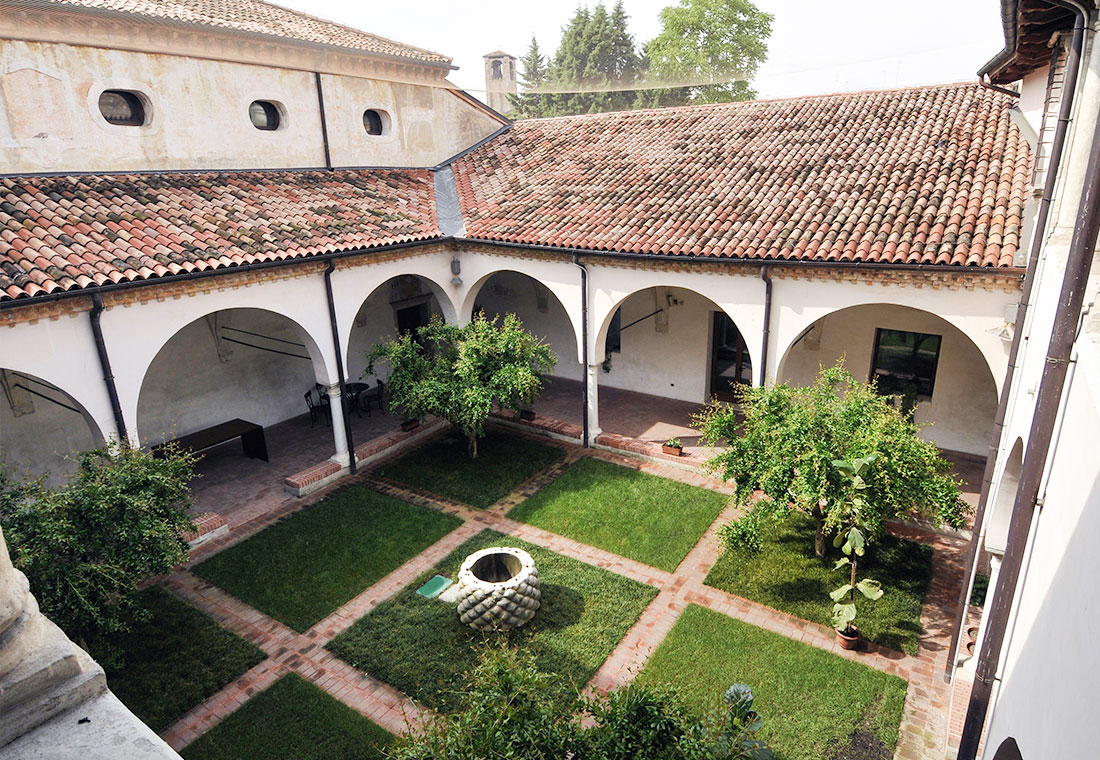
The monastic complex
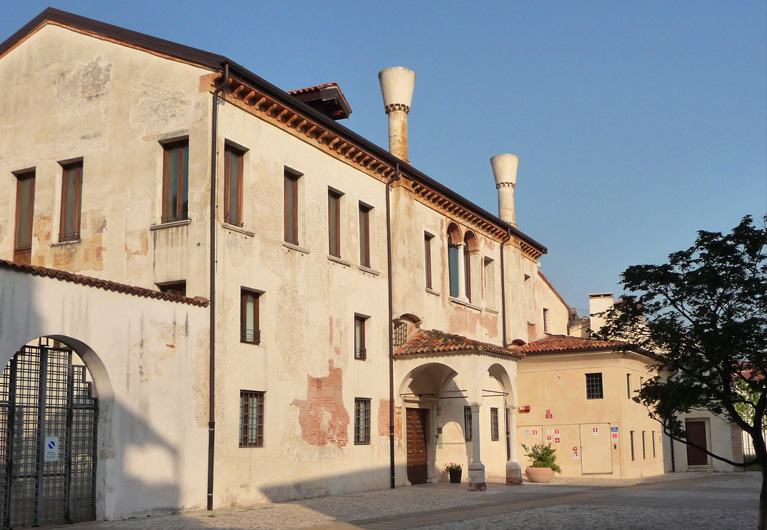
Accessed, by those coming from the city centre via a cross-vaulted late-Renaissance avant-corps, the typically fourteenth-century layout is keyed on two delightful cloisters that were subject to sixteenth-century additions.
The “smaller of the two cloisters" (“il chiostro piccolo”) still bears traces of the original frescoes. The columns of the cross-vaulted ground-floor Renaissance porticato are in white Istria limestone, with rounded arches; there are architraved logge on two sides.
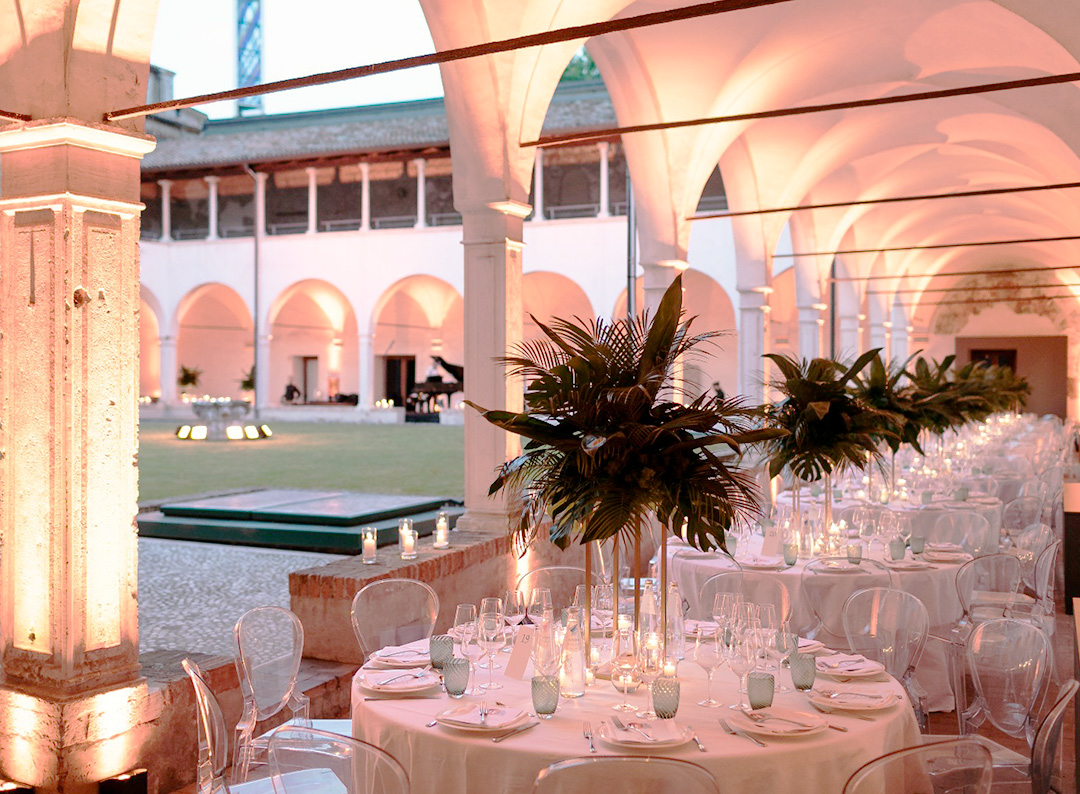
The "larger cloister" (“il chiostro grande”), which is nearly forty metres long, features simple Renaissance lines, is also cross-vaulted and features rounded arches. Above the ground-floor porticato, on two opposite sides, are another set of logge. These re-used the slim columns coming from the original fourteenth-century portico.
The most recent restoration project, at ground level, brought to light a spacious underground room. Named for the engraver and painter Giovanni Barbisan (1914-1988), this area is currently used for temporary exhibitions.
Prior to the modifications carried out in the sixteenth century, the original Chapter Room (Sala del Capitolo), was supposed to be located to the south of the Great Cloister. This is documented in the wall-frescoes showing Christ between the Virgin Mary, Saint Catherine and the saints Filippo Benizi and Pellegrino Laziosi, founders of the Serviti order (Cristo fra la Vergine Maria, santa Caterina e i santi Filippo Benizi e Pellegrino Laziosi, fondatori dell’ordine dei Serviti).
Along this side are a number of square rooms, all of them/some of them bearing traces of wall-frescoes depicting stylised reproductions of textile designs.
Completed in 1620, the main staircase (lo scalone), in Istria stone, the suitably worn from several centuries of use, leads under a vaulted ceiling, to the first floor, which was radically redesigned in the late sixteenth century, along with the Long Gallery.
Opening onto this homogenous space at regular intervals were the monks’ cells. These now constitute the Gallery of Medieval, Renaissance, and Modern Art.