The church of Santa Caterina
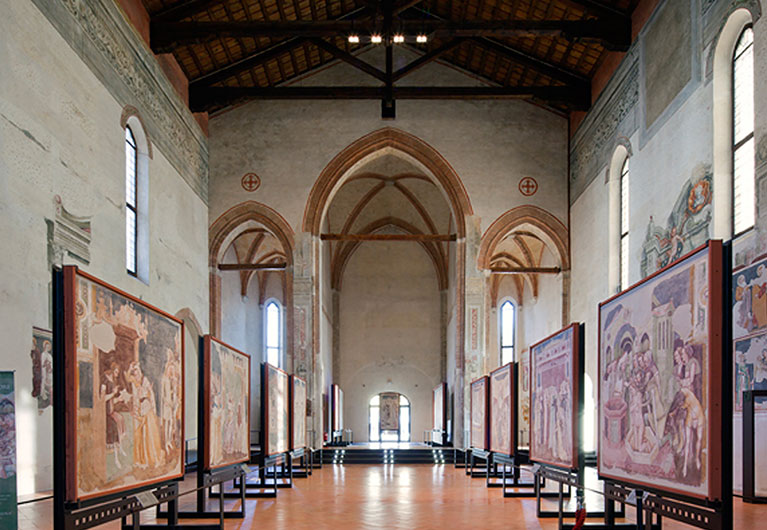
The signature features of the Gothic style can be seen in the three end chapels and in the tall, slim lancet windows.
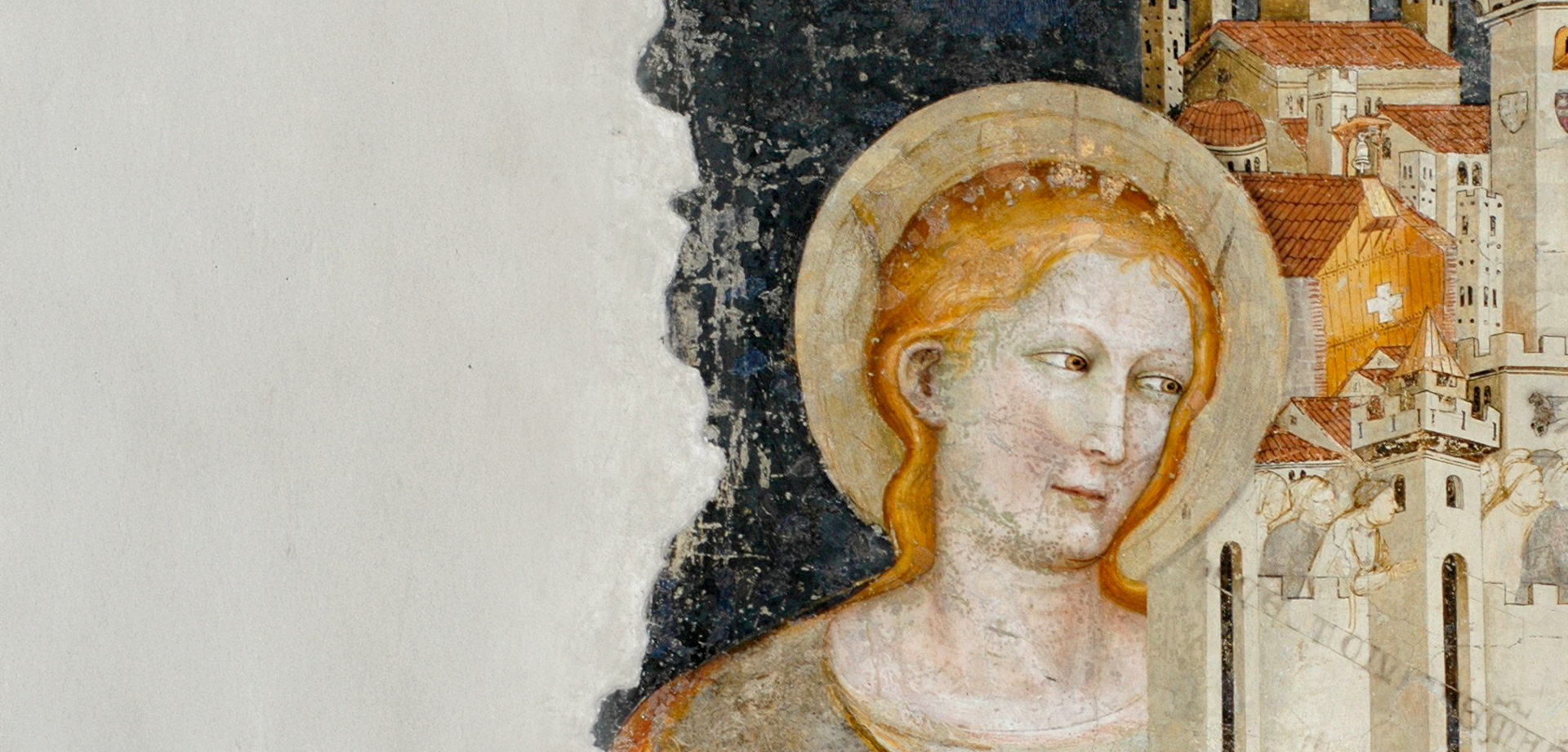
This church was built in two stages. The first started in 1346 from the apse. Work stopped abruptly just two years later, due to a major outbreak of the plague, the result being that a façade of wooden planks was erected as a temporary measure. This is evidenced by a fresco inside the church: Saint Catherine holds up a scale model of the city of Treviso.
Work resumed in the early-fifteenth century, when the building took on its present-day size and shape.
number of chapels were added to the church interior at various times at the express wish and expense of wealthy patrons. Only one survives and is in the southerly section of the church. Named for the Innocents, it was built at the behest of Alberto della Motta, who was from the nearby town of Conegliano, and who was buried here in 1406.
Initially requisitioned by Napoleon, the church underwent heavy-duty remodelling, especially during the Austrian occupation of the city (from 1797 to 1866), since its new role was to be a military warehouse. Stripped of its furnishings, its apses was demolished, and a new (neo-classical) façade added, opening onto the square at the rear.
Internally, three floors were added, the beams piercing the walls and frescoes, with no regard for aesthetics, these infelicitous conditions pertaining until the whole place was restored starting in the early post-war period, to remedy heavy bomb damage during 1944 and 1945.
Thanks to the insight and skills of the restorer Mario Botter, long-forgotten frescoes were brought to light, prompting the decision to restore the entire monastic complex and, eventually, to convert it to its current role as a museum.
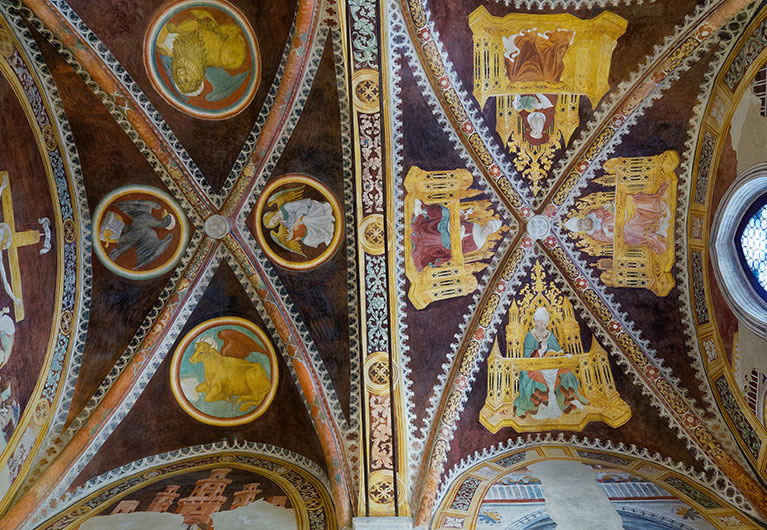
Today’s visitors cannot but be wonderstruck by the sight of so much beautiful fresco work on the walls of this church. These include the outstanding “Madonna and child” attributed to Gentile da Fabriano (c. 1370–1427), as well as the adjacent fifteenth-century Cappella “degli Innocenti”, its cross vaults featuring the Doctors of the Church and the symbols of the Evangelists.
More, there’s Lorenzo Lotto’s cycle of frescoes showing the Stories of Mary (Le storie di Maria), which culminate with the dramatic Crucifixion of the Son (Crocifissione del Figlio).
Predating these works by some two hundred years, but a much later arrival, is Tomaso da Modena’s incomparable cycle narrating the Stories of Saint Ursula (Storie di Sant’Orsola). Originally painted for the nearby church of Santa Margherita degli Eremitani, the frescoes were moved here in 1979.
The Saint Ursula Fresco cycle
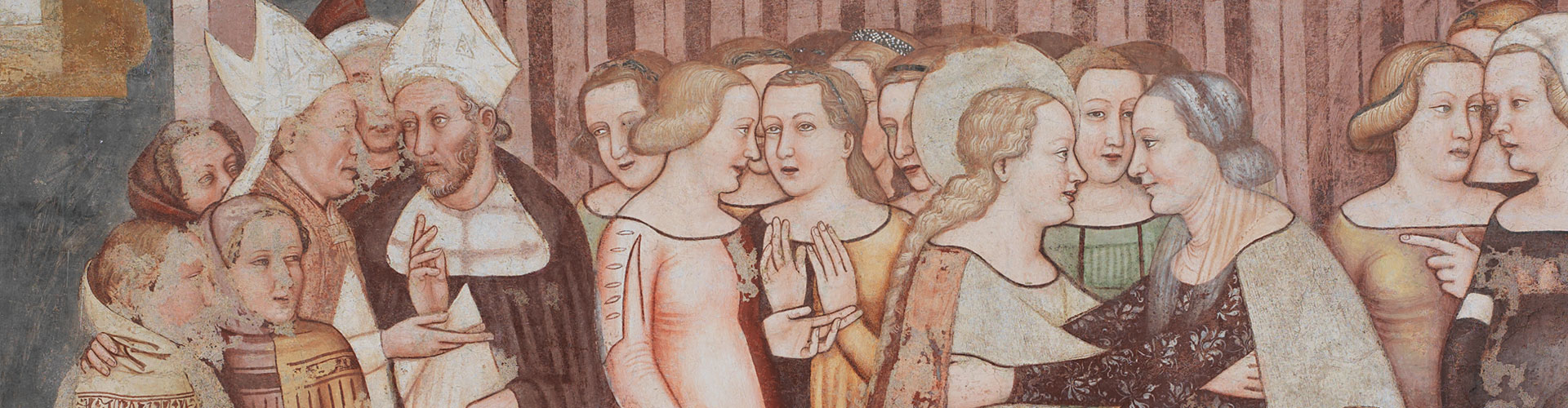
The fresco cycle depicting the Stories of Saint Ursula (Storie di Sant'Orsola) reinterpret an ancient legend in an extraordinarily realistic and dynamic fashion. Painted between 1355 and 1558 circa, by Tomaso da Modena (also spelled Tommaso) these frescoes are among the major masterworks of Italian painting of the Trecento, while being the most important by this particular artist, and are surely the finest of the very many art treasures that Treviso possesses.
Long plastered over, the fresco cycle, located in one of the chapels of the deconsecrated church of Santa Margherita degli Eremitani in Treviso, was rediscovered in 1882, by the abbot Luigi Bailo while the building, which had been relegated to being a stables for the military, was in the throes of being demolished.
Amidst general indifference, while being hurried along by the demolition workers who also got in his way as he worked, and with only two young men, Antonio Carlini, a sculptor and Girolamo Botter, a painter, to help him, and with a lack of funds forcing him to resort to the detachment process (tecnica dello stacco) of removal of the frescoes, Bailo was – against all odds – able to preserve Tomaso’s masterpiece almost in its entirety, securing the rescued works onto flexible wooden frames for transport to their next destination.
Thus was he able to bring the entire cycle of the Stories of Saint Ursula -- an astounding 120 square metres – to the Museum, an enterprise that remains one of the largest such operations ever executed anywhere.
The scenes depicted are taken from the thirteenth-century collection of the lives of the saints known as The Golden Legend (Latin: Legenda aurea or Legenda sanctorum), compiled by Jacopo da Varazze (Jacopo De Fazio, aka the blessed Jacobus de Varagine, in Latin Voragine and in Italian, Giacomo da Varazze, or Jacopo da Varazze; c. 1230–1298).
Ursula, the Christian daughter of the King of Brittany, agreed to marry the (pagan) son of the King of England on condition that he converted and that she might, before her wedding, take a pilgrimage to Rome, accompanied by 11,000 other virgins. Having reached Cologne, the party, accompanied by the Pope, who had been inspired to join them as a result of a dream, were to stop in Cologne to convert the Huns, who were currently occupying the city. Ursula, having caught the eye of the Hun prince, made it plain that she was not interested in him. The outcome was that she, the Pope, and the other 11,000 virgins were promptly martyred.
Framed by the Annunciation scene in the lunette and Saint Ursula enthroned, between the Virgin Mary and the Crucifixion, on the end wall, this dramatic story is masterfully set down by the painter. He depicts the female figures in minute detail, in their stance, in the details of their clothing, as well as the background. Tomaso’s exquisitely refined and elegant style extends to portraying the women’s mood, their facial features and hand gestures, backed by a strong narrative with touches of humour that were quite unknown at the time.
One example is the scene where we see Ursula with her mother: for the first time in the recorded history of art, Ursula’s words are seen coming out of her mouth in the form of a word bubble, comic-book style -- some 9,000 years avant la lettre.
Each scene leads into the next in a finely paced narrative and expressive flow that draws the spectator along right to the very last, and which consists of an epilogue that Tomaso renders with his signature intensity and consummate sense of drama.